Assignment 3: Venture Pitch

Please find my elevator pitch in the video below.

Find my venture pitch in the following video.

Alternatively, you can view it or download it as a PDF.

References

Dogtiev, A. (2022, October 31). App development cost (2022). Business of Apps.

 Facts and Factors. (2022, April 28). Demand for global online language learning. Globe News Wire.  

        https://www.globenewswire.com/en/news-release/2022/04/28/2431759/0/en/Demand-for-
        Global-Online-Language-Learning-Market-Size-Share-Will-Surpass-USD-28-5-Billion-Mark-at-18-8- 
        CAGR-
        Growth-By-2028-e-learning-Industry-Trends-Value-Analysis-Forecast-Repor.html

  Hartery, D. (2020, June 19). App marketing strategies. Adjust.
           https://www.adjust.com/blog/your-guide-to-app-marketing-strategies/

 Iskhakova, K. (2022, July 13). The advantages of language learning apps. E-learning Industry.   

          https://elearningindustry.com/advantages-of-language-learning-   apps#:~:text=Despite%20the%20claims%20of%20language,activities%2C%20and%20meaningful%20soc
         al%20engagement

  PR Newswire. (2022, June 15). Education apps market. PR Newswire.

        https://www.prnewswire.com/in/news-releases/education-apps-market-to-grow-usd-101330-
        million-by-2028-at-a-cagr-of-15-valuates-reports-849249752.html

 Yahoo Finance. (2022, November 21). Education apps market size. Yahoo Finance.   

       https://finance.yahoo.com/news/education-apps-market-size-grow-  
103000805.html?guccounter=1&guce_referrer=aHR0cHM6Ly93d3cuZ29vZ2xlLmNvbS8&guce_referrer_sig=AQAAABCkV_FXdHsyuR_2xC2x4fP2vOP4bMoD1kaZhWZNZ5R4DTdFRD-3r3nRiKP-Bp3yMgwuUyy9vgUbfsxCT-Kv5oOyiCCpx3IFFpVsSenuYuPp13tnh43NqC8zEn2I3S18Ye0gekZMQRX5KlKpdlMpM02FVU-F3ohn88WTpYUkpAZh#:~:text=PR%20Newswire-,Education%20Apps%20Market%20Size%20to%20Grow%20by%20USD%20124782.56%20Million,%2C%20Market%20Dynamics%20%26%20Segmentation%20%2D%20Technavio&text=NEW%20YORK%2C%20Nov.%2021%2C,million%20from%202022%20to%202027

Reflection

Please view the final reflection below.

References:

Issa T. & Isaias P. (2015) Usability and human-computer interaction (HCI). In Sustainable Design (pp. 19-35). Springer, London. 

https://doi-org.ezproxy.library.ubc.ca/10.1007/978-1-4471-6753-2_2

Jenkins, H. (2001). Convergence? I Diverge (Links to an external site.). MIT Technology Review.

Woolgar, S. (1990). Configuring the user: The case of usability trials. The Sociological Review, 38 (1, Suppl.), S58-S99

IP 8 Attention

Can you spot the gorilla? 🙂

References:

de Castell, S. & Jenson, J. (2004). Paying Attention to Attention: New Economies for Learning (Links to an external site.)” Educational Theory, 54 (4): 381 – 397.

Citton, Y. (2017). Introduction and Conclusion: From Attention Economy to Attention EcologyLinks to an external site.. In The Ecology of Attention. John Wiley & Sons.

C.S. Green and D. Bavelier (2012). Learning, Attentional Control, and Action Video Games. (Links to an external site.) Current Biology 22(6), R197–R206.

Ranciere, J. (1991). The Ignorant Schoolmaster (Vol 1). Stanford, CA: Stanford University Press.

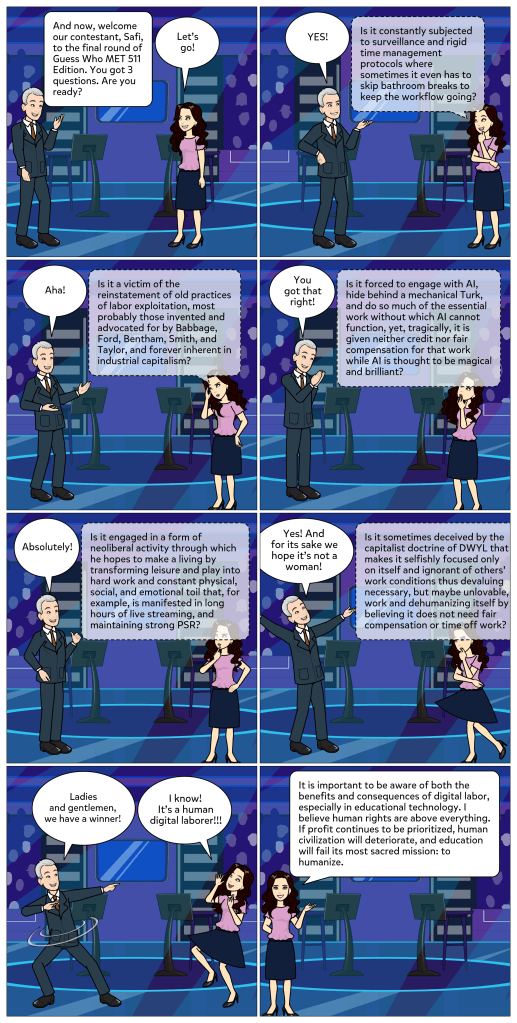
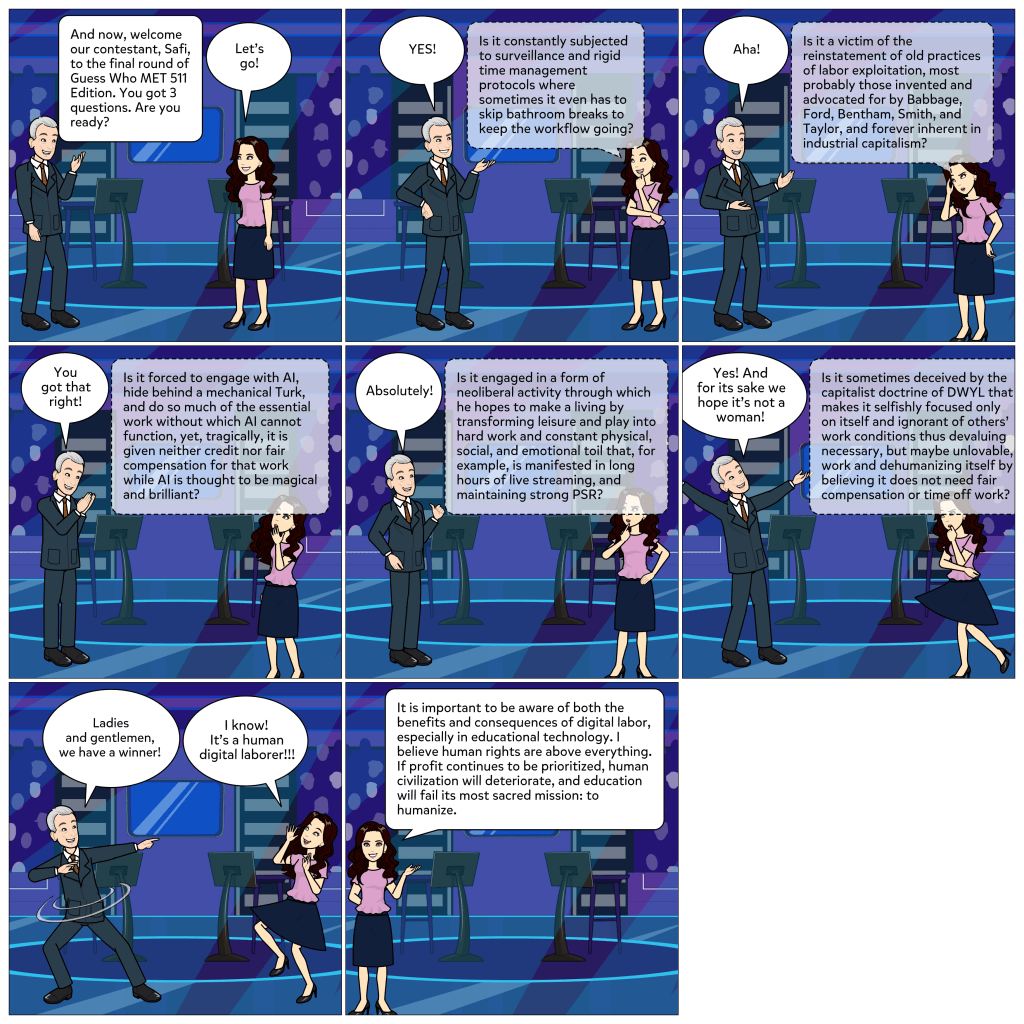
IP 7 Digital Labor

Please view the comic strip below. It can be viewed either horizontally or vertically.

References:

Crawford, K. (2021). Chapter Entitled “Labour.”Links to an external site. In The Atlas of AI. Yale University Press.

Tokumitsu, M. (2014). In the Name of Love. (Links to an external site.) 

Woodcock, J., Johnson, M. (2019). The affective labor and performance of live streaming on Twitch.tv. Television and New Media, 20(8) 813-823

IP 2

Q 1.

  1. Alan Turing was a gifted British mathematician who technically invented the first-ever computer. He laid out the theoretical frameworks for AI through publishing his 1950 paper, ‘’Computing Machinery and Intelligence’’. According to Turing, intelligence is identified as the ability to talk like humans or to pass as a human.
  • John McCarthy was an American mathematician and computer scientist who pioneered AI. His contributions include creating programming languages that have a multitude of applications in several fields, and Timesharing systems which enable global information sharing. He identifies intelligence as the ability to map out the pathway to achieving goals.
  • Herbert Simon was an American political scientist. He created the General Problem Solver program which simulates the human processes of decision-making and problem solving. According to Simon, intelligence is the ability to process and retrieve information to choose the course of action that leads to the best outcomes.
  • Marvin Minsky was an American cognitive and computer scientist. He identified intelligence as having the human capacity for common-sense reasoning. His theoretical work, such as ‘’The Society of Mind’’ theory directed and informed research in AI. His book Perceptrons highlighted problems with neural networks which proved useful for the field.
  • Timnit Gebru is an American computer scientist and AI ethics researcher. She helped diversify the field of AI in addition to revealing hard but important truths about the current state of the tech world. I think she  would define intelligence as the bravery to see injustice and speak up about it.

Q. 2

Human languages are heavily dependant on context; words can chage meanings based on context. In addition, there is space to be creative when using human languages by, for instance, inventing one’s own words that can be perfectly understood by the audience. Moreover, understanding human languages massively relies on taking into consideration non-verbal cues.

 On the other hand, in programming languages context is irrelevant; every unit or line of code means the same wherever it is used. Also, programming langauges are made up of very strict and clear rules; innovation has no place. Finally, non-verbal cues are nonexistent in programming languages.

Q 3.

AI is incredibly much faster at processing data than HI. However, HI has the advantage of being intuitive and able to act in unexpected situations. If anything derails off course, AI fails as it can only perform the tasks it was trained or programmed to perform. Moreover, AI cannot be biased as it acts based on facts only while HI can be opiniontaed and its judgement affected by personal agenda. Unlike AI, HI can lead to new inventions and discoveries. Furthermore, humans are faster at acquiring new skills. AI, in contrast, needs hundreds of years to learn the simplest skills.

Q 4.

Both machine and human learning depends on pattern recognition among large sets of data and model building. If data is not updated, machine learning becomes problematic as it runs the risk of algorithmic bias. Humans have the ability to draw inferences and apply or transfer knowledge to novel situations. Machines, however, can only interpret data inputted in them, not new concepts outside of their domain. Human learning is unique to each person while it is basically the same in all machines. There is a limited number of ways a machine can learn. In contrast, humans have many different learning styles.

Q 5.

My responses were generated based on prior experience, common sense, new knowledge, and my own analysis and synthesis of new knowledge learned. In the case of the machine, the responses would be based on past data already inputted by the designer which might be biased or inaccurate. Generating these responses have transformed my perspective on things, how I understand and will use them in the future. I have formulated my own way of seeing things and making sense of them. A machine cannot do that. It does not have a mind of its own. A machine’s response won’t be as specific as a human’s as it lacks the reasoning needed to choose exactly which information is of the maximum or most efficient relevance and how to best organize it.  However, a machine would definitely be much faster at finding the information required for these responses. But when it comes to selecting, organizing, and analyzing it as per the parameters of this assignment, a human would probably achieve a perfect result at this much faster than it would take the machine to learn how to do it successfully.

IP 1

  1. 1. Usability is a system’s capacity to be easy to use, easy to learn, compatible with the user’s needs, frequently used with minimal error count, safe, memorable, enjoyable to wok with, speedy when accomplishing tasks, informative about achievement of goals, and functional.

2. What is missing from this conception, particularly in relation to education, is the system’s capacity to be educationally valuable. Squires and Preece clarify that, ‘’Just because an interface is easy to use does not mean that it is designed appropriately from an educational perspective.’’ (Squires and Preece, p. 1, 1996). The core purpose of an educational software is to support learning and assist students in achieving learning objectives. If it does not do that, then the software isn’t really ‘’usable’’. Therefore, educational usability could be defined as a system’s capacity to support learning intentions as well as having usability as defined above.

3. The first of Woolgar’s examples that demonstrates how usability testing has gone wrong concerns a group of subjects (users) who are testing a machine. The observers are supposed to objectively observe the subjects as they were performing the tasks without influencing their behavior or intention. However, this was not the case as they intervened multiple times and provided commentary that clearly affected the users’ experience thus rendering the usability testing pointless because the users weren’t ‘’real’’ users as in their behavior was not intuitive and therefore did not reflect the true needs and goals of the intended users of the machine.

The second example is about Ruth, a participant who was assigned the task of connecting Stratus 286 to a printer. Again, the observers make the same mistake of interfering in the task and imposing a certain user experience on the subject. They were telling the participant how the machine is supposed to be used. The observers wanted the user to have an experience that agrees with their expectations, they expected them to use the system in the way they intended, which is the opposite of what usability is about: the system must fulfill the needs of the users and the interaction between the machine and the user must be seamless and natural, not forced.

Usability testing must be performed by the users organically without any influence on their goals, needs, or intentions. The relationship between the system and the user must not be set up or decided (configured) by the observers or the designers of the system. Only the real users’ experience and their authentic satisfaction with the system determines how usable it is.

4. The first position by Issa & Isaias is an optimistic one where they believe usability evaluation is a very successful method of determining usability. Ideally, Issa & Isaias clarify that observers should observe users as they try to accomplish ”true-to-life” tasks. Without the authenticity of users’ behavior, usability testing is pointless, which is what Woolgar sees. and discusses in depth. Usability testing could go wrong as sometimes users and their needs are configured, set up, already decided by the designers which is exactly the opposite of what good usability is all about. Woolgar sheds light on a real and important issue that others might disregard or simply not be aware of. His view is realistic.

References:

Issa T. & Isaias P. (2015) Usability and Human Computer Interaction (HCI). Sustainable  Design. London: Springer. https://doi-org.ezproxy.library.ubc.ca/10.1007/978-1-4471-6753-2_2.

Squires, D & Preece, J. (1996) Usability and learning: Evaluating the potential of educational software. Computers & Education. 27(1) 1996 (p. 15-22). ISSN 0360-1315. https://doi.org/10.1016/0360-1315(96)00010-3.

   Woolgar, S. (1990). Configuring the user: the case of usability trials. The Sociological Review38 (1_suppl), 58-99.

Truth and Reconciliation

Before reading:

Question: What part does education play in Truth and Reconciliation?
Terminology: truth/reconciliation/ education/ representation/ First Nations/ Indians/ Indigenous/ Aboriginal/ Native

After Reading:

Question: How can reconciliation be achieved through education?

Terminology: truth and reconciliation/ colonialism/ education/ representation/ First Nations/ Indians/ Indigenous/ Aboriginal/ Native/ Eurocentrism/cognitive imperialism

Edward Said, in an article he wrote in 2003 for the LA Times, so candidly stated that, ‘’Every empire, however, tells itself and the world that it is unlike all other empires, that its mission is not to plunder and control but to educate and liberate.’’ Thankfully, because the facts about the horrors of residential schools are unraveling, today many of us can say with a great deal of certainty that the ‘’education’’ that colonists had referred to is mainly about Eurocentrism and the white washing of everything native to make it fit the desired perception. That perception favors the white man and forces certain representations of the other (First Nations/ Indians/ Indigenous/ Aboriginal/ Native) that are superficial at best, and deeply demeaning and derogatory at worst. These representations are passed along from one generation to the next, fostered not only in academic curriculums but also in cultural heritages until they become so normalized that the masses don’t even stop for a second to question them and the other, with all their knowledge, culture, and identity, becomes completely forgotten as an independent and worthwhile entity.

Now that this nation is on a pathway to Truth and Reconciliation, it is important to pause for a while and think about what these words mean.
Truth is fundamentally about revealing the truth, confronting it, and finally accepting it for what it is. Reconciliation essentially means repairing the damage, which cannot be done without eliminating intellectual and cultural imperialism.
 It is very clear that there is no true reconciliation without educational reforms (hence the changed question) that are inclusive and respectful, reforms that at their heart do not make any assumptions and that leave it up to (First Nations/ Indians/ Indigenous/ Aboriginal/ Native) people to choose how they want to be represented. It is not a simple task, of course, but one that is worth every effort made and time spent.

Indeed, reconciliation can be achieved through education only and only if that education is free of cognitive imperialism, free of marginalizing indigenous knowledge and experiences, and free of alienating Indigenous people from their race and heritage.


                                                                             References

Battiste, M. (2013) Decolonizing Education: Nourishing the Learning Spirit. Purich Publishing Limited.

Jack, A. (2001). Behind Closed Doors: Stories from the Kamloops Indian Residential School. Theytus Books.

Said, E. (2003). Blind Imperial Arrogance. https://www.latimes.com/archives/la-xpm-2003-jul-20-oe-said20-story.html